By Tom Payne. How do you win the war for talent when skilled people are scarce and tenure keeps shrinking? This article follows up on my earlier piece, Potential, Potential, Who Has Potential? That article explained how the 9-box talent management process evolved. It also showed how organizations use it, with mixed success, to understand their talent supply and future needs.
In The Talent Masters, Bill Conaty (head of HR at GE under Jack Welch) and Ram Charan take an in-depth look at organizations with strong talent management. Notably, the companies they profile make little use of outside talent. Instead, they focus on developing and keeping their own people.
Pressure on the Talent Pool in the War for Talent
As business conditions improve, many firms look to hire and grow. In developing markets, however, they also face a general shortage of well-qualified talent. Two factors have shrunk the global talent supply and intensified the war for talent.
- Inconsistent investment in development. During the last decade, many organizations went through downsizing, re-engineering or mergers. As a result, they spent little time and money on developing talent. For example, fewer companies sponsored employees in executive MBA and global development programs.
- Baby Boomer retirements. This generation is leaving the workforce in large numbers, and it was the group most likely to stay with one employer. By contrast, many new hires say they plan to stay only three to four years. That makes it hard to justify long-term investment in expensive development programs.
Shorter tenure puts more pressure on organizations to assess talent quickly. As I noted in my last article, accurately placing people with leadership potential into executive roles has a strong business case beyond the cost of a failed placement. Ulrich and Smallwood found that investors weigh three variables when valuing a company:
- organizational performance (38%)
- industry favorableness (33%)
- quality of leadership (29%)
The war for talent is here
Investors care about leadership pipelines. Organizations therefore need a sound talent management process that keeps the pipeline full of ready-now and emerging leaders, and clear of obstructions.
In a 2012 global survey of CEOs and CFOs by the Economist Intelligence Unit, 53% said a lack of talent could hurt them financially within 12 months. That figure rose to 67% in organizations with more than 1,500 employees. Also in 2012, Deloitte’s Talent Edge 2020 report found that 83% of executives felt their talent programs needed to improve. In short, more organizations are chasing fewer capable people. The war for talent is upon us.
Stocking Your Internal Talent Pool for the War for Talent
The 9-box matrix helps organizations take inventory of their talent and measure their gaps. It requires separate assessments of each person’s performance and potential. In Potential, Potential, Who Has Potential?, we identified two distinct levels of potential:
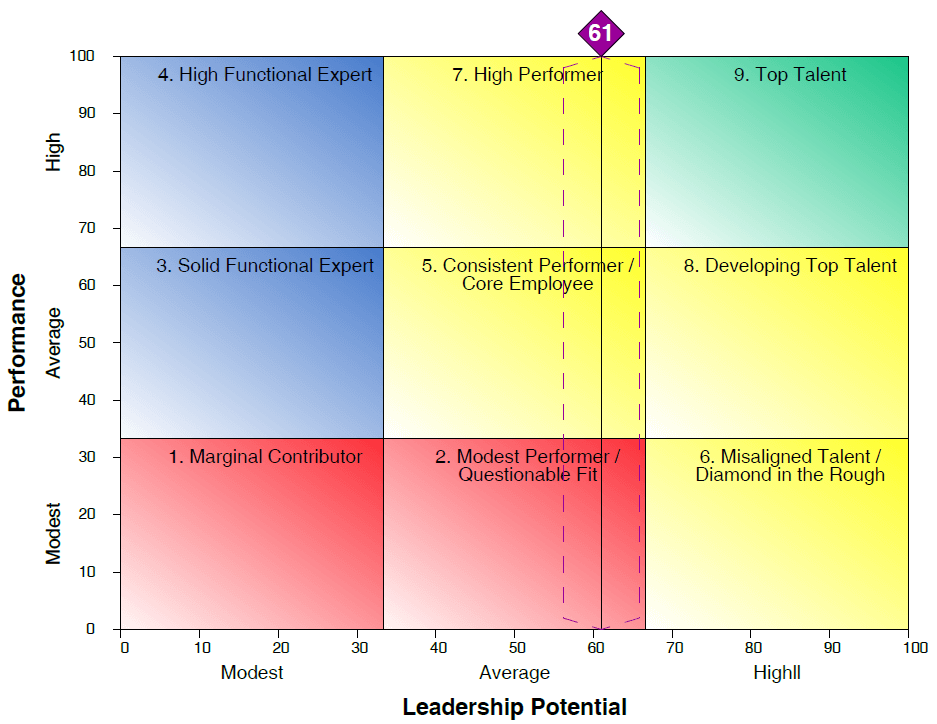
- High performers with potential for bigger contributions within their current function, business or track. In the 9-box, they are typically rated High Functional Expert, High Performer or Consistent Performer.
- High potentials who can succeed in higher, more complex leadership roles beyond their current function or track. In the 9-box, they are typically rated Developing Top Talent or Top Talent.
Figure 1 is from the Leadership Potential Report.
The Peter Principle is alive and well
The most commonly mismanaged career move is from star individual contributor to supervisor or manager. Close behind is the move from manager to executive. The Peter Principle, described by Laurence J. Peter, still thrives in many talent programs. It is the mistake of promoting people for excellent work in their current role into a job with very different demands. Often they are not ready, and they fail.
This happens because most organizations rely on past performance from their performance management process. However, performance management looks backward. It summarizes the last review period. Using it to judge future potential is like driving while looking in the rear-view mirror. It gets even harder when the new role is on a different track.
Silzer and Church (2009) call this the performance-potential paradox. They have called for a new way to measure future potential, especially leadership potential, separately from performance.
Breaking the Paradox
Succession planning versus talent management
Some organizations combine talent management with risk management to name successors for key roles. They ask, “What would we do if Ms. A suddenly left? Who could step in tomorrow?” This emergency list is not always the same as the list of people to develop for future leadership.
In organizations like those in The Talent Masters, the process is so constant and robust that the two lists are 95% the same. In most organizations, though, the succession list holds technically capable people who could cover a role short term. They are not necessarily seen as strong executive leaders. Talent management asks different questions: “Who should we develop for key leadership roles?” and “How and when should we move high potentials into new assignments?”
Make talent a regular executive discussion
Charan and Conaty point out that organizations good at talent management treat it as a core competency. They discuss people as often and as carefully as financial results. They talk openly, compare behavioral observations with business results, and build a shared view of what potential looks like.
Over time, these organizations learn to define and assess leadership potential through regular 9-box reviews. As a result, they make fewer mistakes and more right moves. These companies are winning the war for talent. Their executives also tend to be long-serving, so the shared view becomes part of the corporate DNA. We can learn from the best, but most organizations must adapt these lessons to their own reality.
Winning the War for Talent Starts at Hiring
The world of work is changing fast. Long-term employment no longer seems to appeal to employers or employees. On average, people stay with an organization four years or less. That is far shorter than at the companies in The Talent Masters, such as GE, Hindustan Unilever and P&G.
Today, then, talent management needs to begin with onboarding. That means selection should use proven assessment methods. Schmidt and Hunter (1998) studied which selection methods add the most accuracy. They found that combining structured behavioral interviews, Big Five personality tests, cognitive ability tests, reference checks and work simulations improves predictive power. Organizations that used these methods made better hiring decisions, with lower turnover and fewer failed assignments.
Turn selection data into onboarding coaching
Because tenure is short and talent is scarce, talent management must start on day one. If your selection process is robust, you can trust its assessment of each candidate. Even better, that same data explains why you chose candidate A over candidate B. It shows the new hire’s strengths and development needs.
Sharing this information becomes part of onboarding coaching. After six months of targeted observation, the hiring manager can clearly see progress, or the lack of it, in key areas. Think of the onboarding coaching as the road map and the targeted feedback as the GPS that keeps the new hire on course.
Why this matters most for executives
This approach improves self-awareness and builds the habit of ongoing feedback. It is especially important for new executives. They are busy from day one, and they must build a reputation and manage others’ expectations quickly. They have little time to get it wrong.
An estimated 40% of executive placements fail. Some research attributes over 80% of those failures to poor alignment with culture and values, and to weak relationships with peers and teams. Very few of these leaders want to fail. Often a search firm was paid a large fee to place them. For every new executive, onboarding coaching based on assessment results can help prevent a failed placement.
Telling people why you hired them also helps keep them. With onboarding coaching, retention of new hires can rise by as much as 50%. Executives who get help in their first year are more likely to succeed and stay longer. That directly supports a key goal of talent management, and of any war for talent: keeping your high potentials.
Assessing Potential to Win the War for Talent
Combine assessments with managerial judgment
Silzer and Church advocate a standardized process focused on the traits common to successful leaders. However, they caution that relying only on assessments and leaving out managerial judgment may skip a key step: making sure the culture will accept certain people.
This fits the 9-box model well, where assessments and evaluations are discussed together to place people more fairly and accurately. It also matches the Talent Masters approach of building a shared view of talent by sharing candidate data with the executive team. With relevant, reliable and valid assessments, these discussions become less prone to bias.
Why most high potential labels miss
Silzer and Church have long called for a reliable, valid measure of potential that is separate from performance. By some estimates, only 15% of people rated high potential can truly succeed in executive roles. The main reason is over-reliance on technical skill and recent performance, which is the Peter Principle again.
Several assessments aim to identify potential. One concept is learning agility, a personality-based measure of a person’s attitude toward continuous, flexible learning. People who score high tend to embrace learning and handle ambiguity and change well.
The Leadership Potential Report
Another tool showing great promise is the Leadership Potential Report (LPR). It identifies people with the potential to be Top Talent or Developing Talent in 9-box terms. These are the people who clear two hurdles, high potential and high performance, typically the top 15% of your talent pool.
The LPR builds an overall rating from three facets of cognitive ability and four facets of personality closely tied to executive success. It gives equal weight to both halves. As a result, organizations can measure leadership potential, which looks forward, separately from performance, which looks back. This helps overcome the Peter Principle.
Intellect Gets You There, Personality Keeps You There
Malcolm Gladwell makes a related point in Outliers. IQ clearly separates people by cognitive capability, but its value in predicting success has limits. Above a threshold of roughly 120, he argues, other factors, many related to personality, matter more.
Similarly, Sydney Finkelstein, author of Why Smart Executives Fail, studied spectacular failures over six years. He found that most of the CEOs’ deadly habits came from unchecked egos. David Dotlich and Peter Cairo, in Why CEOs Fail, describe 11 derailing behaviors, most tied to poor personality fit. Even so, motivation, achievement and ambition are strong traits of successful leaders. These traits can be seen in advance and refined through coaching.
Executives also face ever more complex decisions, as Berman and Karsten (2010) describe. David Campbell, in If I’m in Charge Here, Why Is Everybody Laughing? (fourth edition, 2014), notes that leaders tend to be smart, often one or two standard deviations above average. From there, they climb an upward spiral of experience, creativity and leadership. He adds that the most successful leaders consistently seek and use feedback. In other words, intellect can get you there, but personality keeps you there.
Summary: How to Win the War for Talent
Assessing potential clearly requires looking at both intellectual capacity and key enabling personality traits. The LPR combines cognitive ability with four of the Big Five personality traits linked to executive success. The resulting potential score goes on the potential axis of the 9-box, and the performance rating goes on the other. Where they meet places each person in the most fitting box.
This makes the 9-box a more objective talent tool. It also provides the standardized measure of potential, separate from performance, that Silzer and Church called for, breaking the performance-potential paradox.
Of course, culture and situation, such as a business turnaround, still shape who is seen as high potential. Managerial judgment still matters. But with a more accurate, predictive assessment, talent discussions become less prone to bias and politics. They also become fairer, faster and more productive. That is how you win the war for talent. To learn more, contact AAI.
