Potential for what? Executives often push back on measuring potential. They doubt it can be measured, and they hesitate to make people decisions based on it. Yet they make those decisions anyway, so it pays to measure leadership potential well. Every year they decide who gets the break-out assignment or the next promotion, often without any data.
Indeed, few decisions have more impact on a career, or on the success of a company, than choosing who will take on leadership roles. In this article, we look at what leadership potential is, how to measure it, and how to use it in your talent reviews.
What Venture Capitalists Teach Us About Potential
A few years ago I spent time in Silicon Valley, meeting with venture capital firms like Kleiner Perkins, Redpoint and Mayfield. One theme surprised me. Venture capitalists bet big dollars on great ideas. More importantly, though, they bet on the entrepreneur.
These are inventors who are passionate about building a solution that works in the market. Often the first great idea changes along the way. It gets tested, adjusted, stretched and developed as it comes to market and grows. Sometimes the first solution is rejected outright. Even so, the core idea and the drive to get it right keep investors confident.
So it is with leaders. Similarly, a leader’s strong performance to date is like the inventor’s great idea. It catches the attention of senior management. But is past performance enough to justify a major investment of time and resources?
The future will test that leader in ways we cannot predict. How will she adjust, stretch and grow as the work becomes more complex? Insight into her potential makes the right call more likely. Potential can be identified and measured. That measurement can then guide how you develop leaders and build a bench of ready successors.
“Today those responsible for hiring and promotion decisions must instead focus on potential…” – Claudio Fernández-Aráoz, Harvard Business Review
What Is Leadership Potential?
Ask any thoughtful leader and you will hear a point of view on potential, often shaped by their own experience. “You can tell a leader has potential because he has vision… or charisma… or smarts… or tenacity.” Or perhaps: “I can’t describe it, but I know it when I see it.”
Fortunately, research is helping us describe it and measure it. Silzer and Church (2009) report that potential can be measured through cognitive ability and personality.
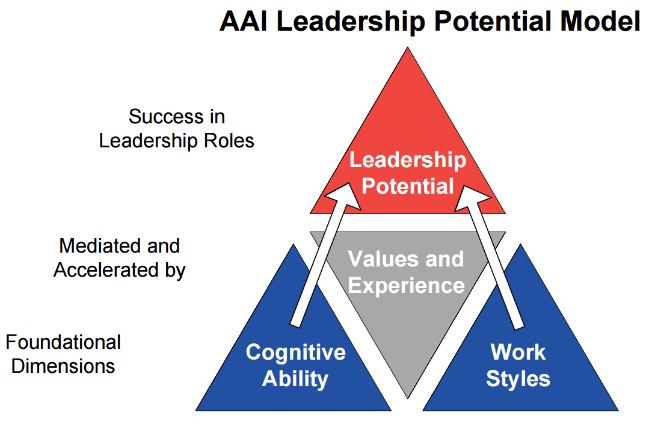
In this model, leadership potential rests on foundational, intrinsic attributes. These are cognitive ability and personality (or work styles). Next, values and experiences shaped by outside forces build on that foundation. Finally, everything plays out in the context and culture of the organization, which shapes success in leadership roles.
Cognitive ability is a foundation
Successful leaders typically score higher on cognitive assessments. Hunter and Hunter (1984) show that cognitive ability has a positive effect on job performance. Korn Ferry’s data shows that high-IQ executives tend to be high performers (Lewis, 2014). In addition, Fortune 500 CEOs and billionaires score higher on cognitive tests (Wai, 2013).
Personality matters just as much
Even so, cognitive ability alone does not predict potential. Personality is an equally important foundation. How leaders handle their motivations, their work and their coworkers directly drives their success, or derails it. Harvard Business Review reports that intelligence alone is not enough to spot potential (Fernández-Aráoz, 2014).
In fact, most leaders who fail to progress do so because of derailing behaviors or a poor fit with company culture, not cognitive limits. Zenger and Folkman (2009) studied 450 Fortune 500 executives and more than 11,000 leaders. They identified the ten most common leadership shortcomings that led to firing or to bottom-10% rankings in 360 feedback. Eight of the ten fatal flaws are rooted in personality and work styles. The good news is that these traits can be identified and measured.
Experience and values shape the rest
Together, cognitive ability and work styles form the base, but they do not tell the whole story. Potential is also shaped by experience, such as an expatriate assignment, owning a P&L or leading a turnaround. It is also influenced by values, such as passion for the company’s mission or a choice to decline a move while children are in high school.
Talent reviews, with or without a 9-box format, help bring these decisions into the open. However, apart from past performance ratings, they usually lack data and are often highly subjective. When you measure leadership potential, you bring objectivity and comparability into the discussion.
How Do You Measure Leadership Potential?
Several assessments aim to identify potential. Here are two common approaches.
Learning agility as a proxy
One concept gaining attention is learning agility. It is a personality-based measure of a person’s attitude toward continuous, flexible learning. People who score high on learning agility tend to embrace learning and handle ambiguity and change well.
Clearly, in a fast-paced world, that is a real advantage. But does it also mean a person has high potential to succeed as a leader? As we have seen, potential involves more than learning and adapting.
Measure leadership potential directly with the LPR
Another tool showing great promise is the Leadership Potential Report (LPR). Rather than using learning agility as a stand-in for potential, the LPR directly assesses a leader’s cognitive ability and work styles. The result is a potential profile and an overall score.
The LPR builds its overall rating from three facets of cognitive ability and four facets of personality closely linked to successful executive performance:

- Cognitive ability. Johnson and Bouchard (2005) and Page (2009) offer similar models of cognitive ability based on verbal, numerical and abstract reasoning.
- Personality, or work styles. These are the personality and motivational traits that shape behavior at work, anchored to the Big Five personality factors (Barrick & Mount, 1991). The four facets are Interpersonal Acumen, Thinking Acumen, Results Acumen and Emotional Acumen.
The LPR gives equal weight to these two halves: the four personality facets (anchored to the Big Five and partly aligned with learning agility) and the three facets of cognitive ability.
Why Measure Leadership Potential in Talent Reviews
Many organizations compare leaders on performance and potential to identify top talent, often with a 9-box grid. When I led these sessions, we usually used recent performance appraisal ratings for the performance axis.
For potential, however, we often had no data at all. I have used nominal sorting, company values ratings and descriptive criteria to have managers sort their leaders ahead of time. None of these were objective, and none allowed fair comparisons across leaders. In some cases, the potential rating had more to do with how well a manager presented a leader than with the leader’s actual potential.
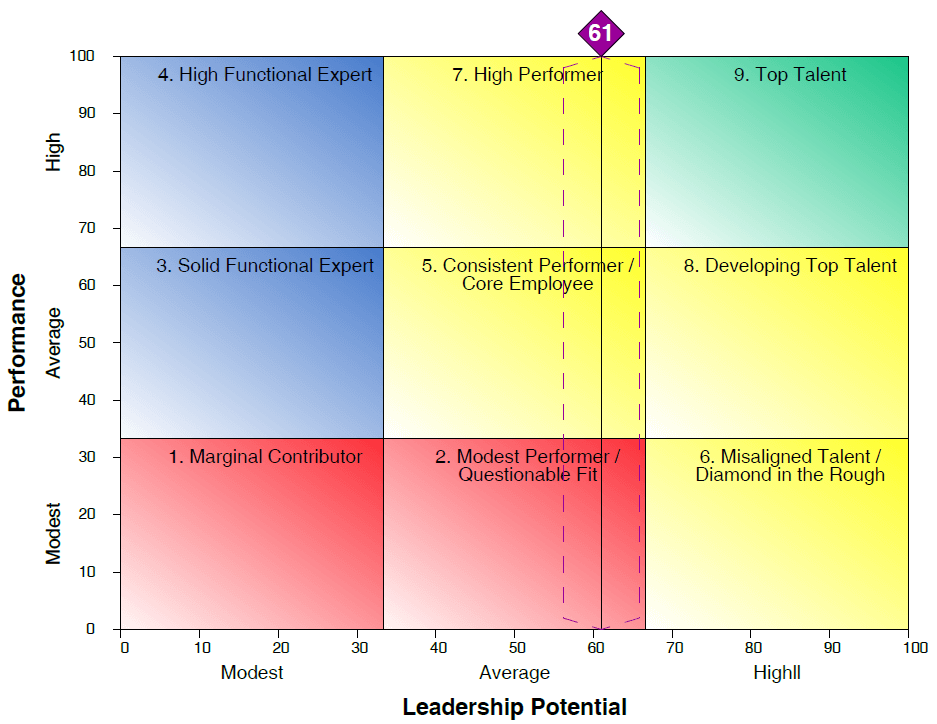
In a 9-box discussion, the LPR adds an objective potential score for each leader, based on assessed cognitive ability and work styles. Of course, reducing a talented leader’s future to a single score is an oversimplification. Still, a valid data point that can be compared across leaders is a big step forward for the quality of the conversation.
This is also especially valuable for multinational companies, because the LPR is available in multiple languages. Few measures objectively compare leaders across countries, cultures and languages. LPR results can be a great equalizer for those first comparisons.
Then, after the talent review, the organization can agree on its top talent: the leaders with both high potential and high performance. It can then focus its development resources on accelerating their growth.
Conclusion: Make Better Talent Calls
To sum up, every organization makes talent decisions. Some use performance data, and some use gut feel. Some have a long-standing talent review process, while others are just discovering the need for one.
Leadership potential is a powerful underlying factor that helps predict future success. It is grounded in cognitive ability and personality traits, and both can be measured. When you measure leadership potential with tools like the Leadership Potential Report, talent reviews become more objective, valid and successful.
In short, you can be confident you are making the right call when you tag leaders as high potential. Then you can speed the development of the people most likely to succeed. To learn more, contact AAI.
References
Barrick, M. R. and Mount, M. K. 1991. “The Big Five Personality Dimensions and Job Performance: A Meta-analysis.” Personnel Psychology, 44, 1-26.
Fernández-Aráoz, C. 2014. “21st Century Talent Spotting.” Harvard Business Review, June 2014.
Hunter, J. E. and Hunter, R. F. 1984. “Validity and Utility of Alternative Predictors of Job Performance.” Psychological Bulletin, 96(1), 72-98.
Johnson, W. and Bouchard, T. J., Jr. 2005. “The structure of human intelligence: It is verbal, perceptual, and image rotation (VPR), not fluid and crystallized.” Intelligence, 33, 393-416.
Lewis, J. 2014. “Executive Insights: When is high IQ a liability for an executive?” Korn Ferry Institute.
Page, R. 2009. Applied Reasoning Test Manual.
Silzer, R. F. and Church, A. H. 2009. “The Pearls and Perils of Identifying Potential.” Industrial and Organizational Psychology, 2(4), 377-412.
Wai, J. 2013. “Investigating America’s elite: Cognitive ability, education, and sex differences.” Intelligence, 41, 203-211.
Zenger, J. and Folkman, J. 2009. “Ten Fatal Flaws That Derail Leaders.” Harvard Business Review, June 2009.
